
Benidorm has a reputation which arrives well before you do. The skyline alone – a Manhattan-esque cluster of high-rises rising from the Costa Blanca coast – tends to trigger strong reactions in people who have never been there. The British tabloid image of all-inclusive excess and full English breakfasts dies hard. The thing is, it is not entirely wrong, but it tells about a quarter of the story. If you are wondering what are the other things to do in Benidorm beyond lying on the beach, the answer is rather more than most people expect.
What those who dismiss Benidorm tend to overlook is that this is first and foremost a Spanish resort. The resident population sits at over 60,000. Spanish families from Valencia, Murcia and Madrid have been coming here for generations, and they aren’t coming for the karaoke bars. They are coming for two of the best-maintained Blue Flag beaches on the Mediterranean, a climate which makes almost every other European resort look underpowered and a relaxed well-organised town which knows how to handle tourism on a large scale without entirely losing itself.
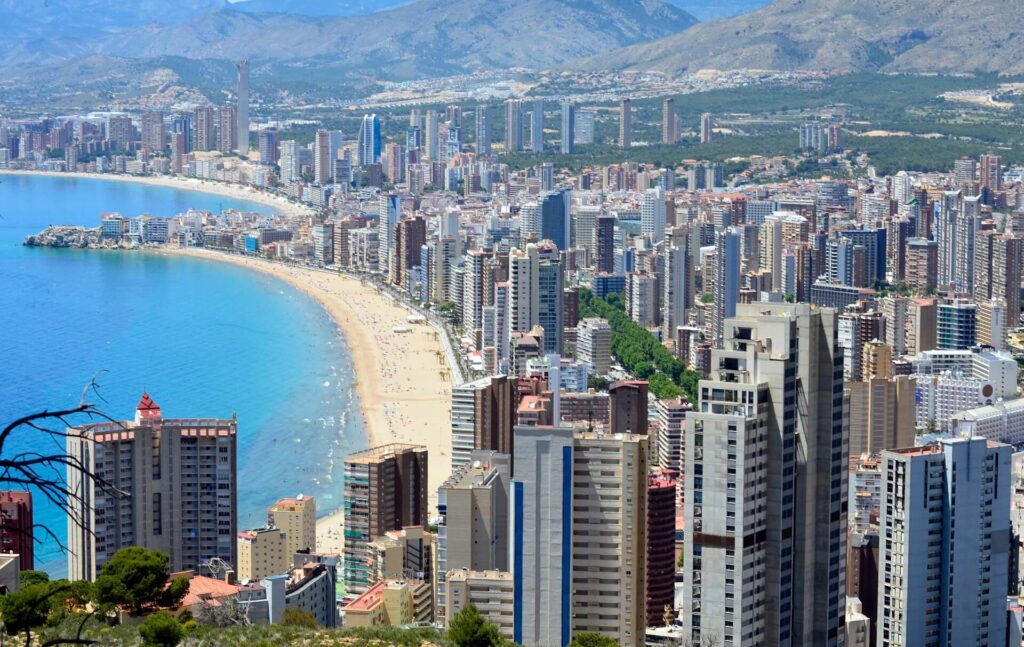
The old fishing village at the centre of it all is still there if you look for it. The domed church on its rocky promontory, the narrow streets of the casco antiguo, Calle Santo Domingo with its row of proper tapas bars – none of this features in the brochures, which is partly why it remains worth visiting. Benidorm also sits in the middle of a stretch of Costa Blanca coastline with some genuinely good day trip options: a hill village perched on a limestone pinnacle, natural waterfalls you can swim beneath and the looming bulk of the Peñón de Ifach rising from the sea at Calpe.
None of this means Benidorm is for everyone. If you want somewhere quiet and unspoilt, this is not your destination. But approached on its own terms, the things to do in Benidorm cover considerably more ground than the resort’s reputation suggests.
Best Things to Do in Benidorm
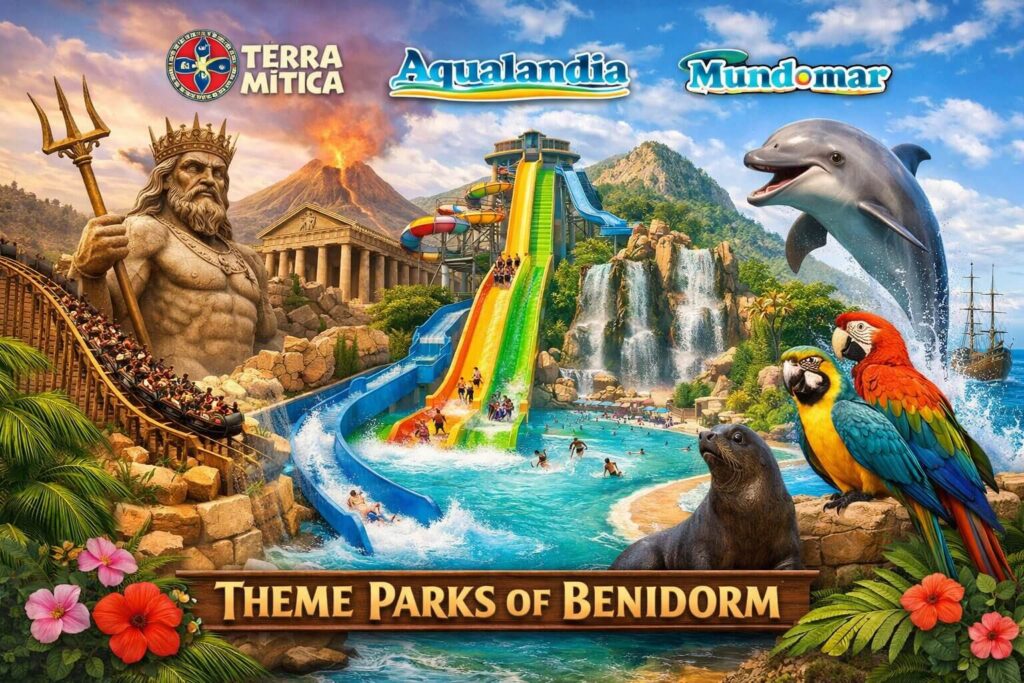
Visit the Theme Parks
Benidorm has built a cluster of theme parks which are amongst the best in Spain and which account for a significant part of the resort’s pull for families. They sit in the hills above the town and most visitors sensibly tackle one per day.
Terra Mitica is the most ambitious of the group – a large park themed around the ancient civilisations of the Mediterranean, with separate zones for Egypt, Greece, Rome, Iberia and Carthage. The rides are substantial enough for teenagers and the theming is more considered than you might expect from a Spanish theme park. It is a full-day visit. More Information at the Terra Mitica official site.
Aqualandia is one of the larger water parks in Europe and tends to be the undisputed favourite for younger children. The range of slides runs from shallow splash pools at one end to genuinely nerve-testing drops at the other. On a hot August afternoon in Benidorm it is difficult to argue with. More Information at the Aqualandia official site.
Terra Natura combines a zoo with a water park, which sounds like an odd arrangement but works reasonably well in practice. The animal enclosures are spacious by Spanish standards and the wildlife section alone fills a morning comfortably. It is a good option for families with a wide age range to satisfy. More Information at the Terra Natura official site.
Mundomar focuses on marine animals and puts on shows involving dolphins and sea lions. It is worth knowing that attitudes towards performing marine animals have shifted considerably in recent years and that animal welfare standards in such venues vary. Some visitors are comfortable with it; others are not. Worth considering before booking. More Information at the Mundomar official site.
All four of these theme parks in Benidorm offer combination tickets and online discounts are regularly available. Check the individual official websites for current prices and seasonal opening dates.
The Benidorm Fiestas
The annual Festes Majors Patronals de Benidorm take place over five or six days beginning on the Friday of the second weekend of November. They are the most important event in the local calendar and draw a very different crowd from the summer beach season – this is local celebration in the proper Spanish sense, rooted in a specific piece of the town’s history.
The origin of the fiestas dates to 1740, when a fishing boat washed ashore without its crew. Fearing the plague, the villagers burnt the vessel. Amongst the ashes they found an intact statue of the Virgin, undamaged by the fire. She became known as La Virgen del Sufragio and, alongside Saint James the Apostle, is venerated as one of the patron saints of Benidorm. The fiestas commemorate that discovery every year on the second Sunday of November.

The programme includes the official opening of the fairground, the Entrada de Penyes procession through the town centre, a re-enactment of the Virgin’s discovery on Poniente Beach and several evenings of live music in the Plaza de SS.MM. Reyes de España. The week concludes with a multicoloured float parade and a fireworks display. There is also a British Fancy Dress Party on the day after the official close – an addition which says something about how Benidorm has absorbed its different communities into a single slightly surreal whole.
If you are visiting in November, timing your trip around the fiestas is worth doing. The town feels very different from its summer self: quieter, warmer in the community sense and considerably more Spanish.
The Beaches
Benidorm’s two main beaches are the reason the town exists and both are genuinely well run. They hold EU Blue Flag status and are cleaned every night.
Playa Levante, the northern beach, stretches for around 2km and is the livelier of the two. The promenade behind it is largely traffic-free, lined with cafés and bars and popular with northern European visitors. It offers sunbeds, a beach library (the Biblioplaya), children’s play areas and the usual range of water sports. The wheelchair accessibility along the promenade is good.
Playa Poniente runs for about 3km to the south and is noticeably calmer. The beach is slightly narrower and a road separates it from the hotels, but it is better suited to families wanting a quieter morning. It is also the beach used for the Virgin re-enactment during the November fiestas.
For a different experience entirely, the smaller Playa Mal Pas sits at the foot of the old town headland and attracts a more local crowd. The setting – beneath the old church, away from the main resort noise – gives it a character the main beaches lack.
The Old Town and Tapas Alley
El Casco Antiguo – the old town – sits on the promontory between the two main beaches and is the part of Benidorm which most package tourists never find. It is worth an hour or two of any stay.
The focal point is Balcón del Mediterráneo, the viewpoint at the tip of the headland with a panorama across both bays and, on clear days, out towards Ibiza. The church of San Jaime y Santa Ana, with its distinctive blue-tiled dome, stands alongside. It is the image most associated with old Benidorm and inside it is a working parish church with a calm that contrasts sharply with the resort around it.
The streets of the old town lead into Calle Santo Domingo, known to regulars as Tapas Alley. This short street is lined with traditional tapas bars – small unpretentious places serving the kind of food that has nothing to do with the British pub fare available a few streets away. The format is the classic Spanish crawl: a small plate and a drink at one bar, move on to the next. Patatas bravas, croquetas, pimientos de padrón, fresh anchovies from the Costa Blanca coast. The prices are fair and the atmosphere in the evening is about as Spanish as anything you will find in this part of the province of Alicante.

The Pueblo Street Market
The Mercado Rincón de Loix, universally known as the Pueblo market, takes place every Wednesday and Sunday morning on Avenida de L’Admirall Bernat de Sarria, next to the Pueblo Benidorm Hotel. It is one of the larger street markets on the Costa Blanca – clothing, leather goods, local produce and the usual mix of tourist souvenirs alongside stalls which clearly serve the local population rather than the holiday crowd.
It runs year-round and is busiest in summer. Arriving early is worth the effort; by late morning in July and August it becomes genuinely uncomfortable.
Nightlife and Evening Entertainment
Benidorm’s evening scene is large enough to have its own geography and it helps to understand it before you wander in.
The Levante strip behind the northern beach caters predominantly to younger tourists – bars and clubs offering karaoke, live music and DJ sets until the early hours. The English Square (Rincón de Loix) is the heart of the British-oriented scene and makes no pretence about what it is. For those who want it, it delivers efficiently. For those who do not, it is easily avoided by staying on the other side of the old town.
The stand-out venue for evening entertainment is Benidorm Palace on Avenida de l’Albir, which has been putting on large-scale cabaret and dinner shows since 1977. The production values are high – a full live band, dancers, acrobats and a rotating cast of variety acts – and it draws a genuinely mixed crowd of Spanish families, couples and visitors of all ages. It is not cheap but it is a long way from the typical Costa Blanca tourist show. More Information at the Benidorm Palace official site.
For a quieter evening, the Old Town offers restaurants with outdoor tables and smaller bars along the streets leading down from the Balcón del Mediterráneo. The marina area to the south has a handful of cocktail bars with a more relaxed atmosphere – La Cava on the marina strip is worth knowing about for a drink before or after dinner.
Day Trips from Benidorm
Benidorm’s position on the Costa Blanca makes it a practical base for exploring a stretch of coast and hinterland which most visitors never see from their sunloungers.
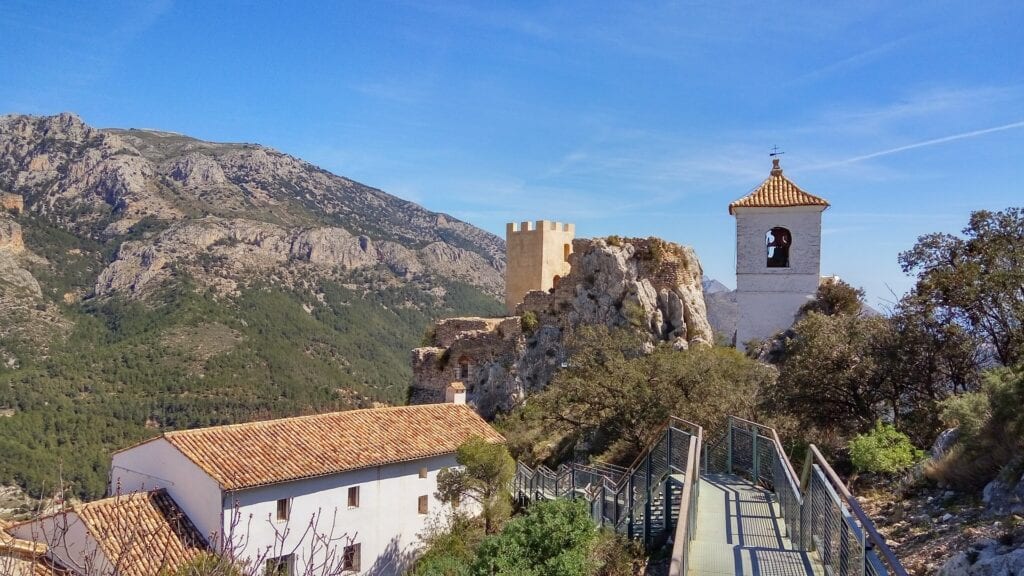
Guadalest is the most popular excursion and rightly so. The village sits on a limestone pinnacle in the mountains above Benidorm, accessible only through a tunnel cut into the rock. The views across the reservoir and the surrounding sierra are considerable and the village itself, whilst small, has a castle, a cemetery perched on the highest point and a handful of good local craft shops. Tour groups arrive in numbers by late morning; going early or late makes a real difference.
Fonts de l’Algar – the Algar Waterfalls – are around 20km inland and offer a series of natural pools fed by a mountain stream, surrounded by carob and orange trees. You can swim in the pools. In spring the water levels are higher and the vegetation more lush; in summer it fills up but remains worth the trip.
Altea, a short drive up the coast, is the quiet counterpoint to Benidorm’s noise. The old town on the hill above the seafront has whitewashed houses, a blue-domed church and a small arts community which has been establishing itself there for decades. There are good restaurants along the seafront.
Calpe and the Peñón de Ifach are worth half a day. The Peñón is a massive limestone outcrop – 332 metres – rising almost vertically from the sea and connected to the town by a narrow isthmus. A well-marked path through a natural park leads to the summit. The views back down the coast towards Benidorm and north towards the Montgó massif are worth every step of the climb.
Valencia is 130km to the north and reachable by train in around 90 minutes from Benidorm’s TRAM station at Benidorm. The City of Arts and Sciences alone justifies the trip, and the old city around the cathedral and the Mercado Central is one of the best historic centres in Spain. Renfe timetables and bookings
For more information, check out our guide to the Best Day Trips from Benidorm.
More on Spain from Spanish-Fiestas.com
Our travel guides cover Spain’s most visited cities and regions in depth – where to stay, what to eat, when to go and what the other guides miss. Browse the full list at amazon.com/author/gerrykerkhof.
Questions About Benidorm
When did tourism begin in Benidorm?
The modern resort dates from the early 1960s when Benidorm was still a small fishing village centred on the church above the old town. The then-mayor, Pedro Zaragoza Orts, played a decisive role in opening the town to foreign tourism – a decision which transformed it beyond recognition within a generation. By the 1970s the high-rise construction which defines the skyline today was well underway. The Gran Hotel Bali on Calle Luis Prendes, at 186 metres the tallest building in the resort, gives some sense of the scale of what was built. Today the Benidorm Tourism Office can help with information on local events and attractions.
When is the best time to visit Benidorm?
The Sierra Helada ridge behind the resort shelters it from northerly winds and gives Benidorm one of the mildest microclimates on the Spanish mainland. Winter daytime temperatures rarely drop below 10°C and sunny days in January and February are common. The beaches are quiet, the town is calm and the prices are lower than in summer.
July and August are the busiest months by a considerable margin. Temperatures average around 30°C but can reach 40°C in the early afternoon, with summer humidity adding to the heat. Spring – particularly April and May – and early autumn offer a good balance: warm enough for the beach, lively enough to feel like a resort, without the full pressure of the peak season.
The Benidorm Fiestas in November are worth timing a trip around if Spanish cultural celebrations interest you more than beach holidays.
How do you get to Benidorm?
The nearest airport is Alicante-Elche (ALC), around 60km south. The most practical connection is the direct bus service operated by ALSA, which departs from outside the arrivals terminal approximately every hour. The journey takes around 50 minutes. Tickets can be booked in advance on the ALSA website.
Taxis from the airport cost considerably more and are worth considering mainly for groups or awkward arrival times. Private transfers can be pre-booked online and offer a middle ground between the two.
The FGV TRAM service connects Benidorm northward along the coast to Altea, Calpe and Dénia – useful for day trips and more scenic than the main road. For Valencia, connections via Renfe are the most practical option.
Before You Go
The old town and Tapas Alley are within easy walking distance of both main beaches and deserve at least one evening of any Benidorm stay. The theme parks sit in the hills above the town and are best reached by taxi or the parks’ own shuttle services; the distances look manageable on a map but are not pleasant on foot in summer heat.
Benidorm will never be a quiet destination and it makes no attempt to be one. But the beach quality is genuine, the old town is worth exploring and the things to do in Benidorm extend well beyond what most visitors realise before they arrive.


