
The decision to build the Guggenheim Museum in Bilbao was, by any measure, audacious. Spend hundreds of millions on a contemporary art museum in a declining industrial city that most Europeans couldn’t locate on a map? The opposition was fierce and entirely reasonable. Why not spend that money on schools, infrastructure, social programmes – things people actually needed?
Yet here we are, nearly three decades later, and that gamble has fundamentally transformed not just Bilbao but how cities worldwide think about cultural regeneration. The Guggenheim opened in 1997, Frank Gehry’s titanium-clad masterpiece rising from former docklands beside the Nervión River. Almost overnight, Bilbao shifted from somewhere tourists avoided to a must-see destination. The “Bilbao Effect” entered urban planning vocabulary as shorthand for museum-led regeneration.
I’ve returned to the Guggenheim Museum Bilbao on numerous occasions since those early years, watching it evolve from controversial novelty to established icon. The building still provokes strong reactions – you either find Gehry’s deconstructivist architecture thrilling or appalling, rarely anything between. But its impact on Bilbao is undeniable, and whether you care about contemporary art or not, the museum deserves attention for what it represents and what it’s achieved.
This guide covers everything you need to know about visiting the Guggenheim Bilbao – from understanding its architecture and seeing what’s inside to practical information and honest assessment of whether it lives up to the hype. Take a look at our Bilbao City Guide for ideas of other things to do in Bilbao.

The Architecture: Why the Building Matters
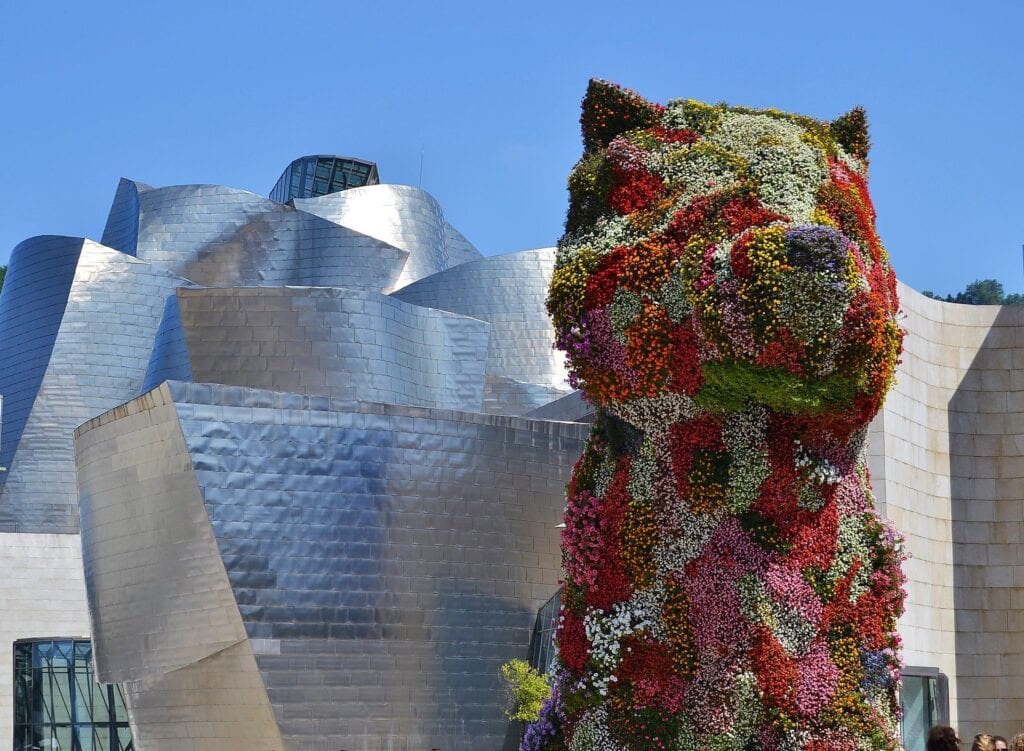
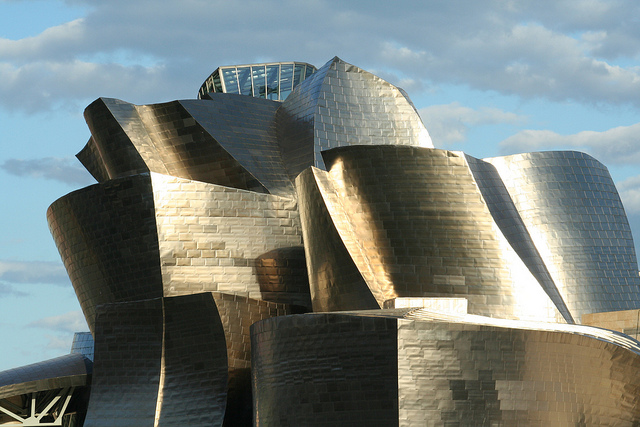
Frank Gehry designed the Guggenheim on 24,000 square metres of former dockland, deliberately referencing Bilbao’s industrial and maritime past. The building’s forms suggest both ships and fish – two elements central to the city’s history when shipbuilding and fishing dominated the economy. Those soft undulating lines viewed from the riverside genuinely evoke a vessel, whilst the titanium cladding creates surfaces that shift constantly with changing light.
And Bilbao’s weather changes frequently, so the museum transforms throughout the day – gleaming silver in morning sun, turning almost golden at sunset, appearing ethereal and ghostly in the mist that often rolls in from the Bay of Biscay. The 33,000 titanium plates covering the structure are just half a millimetre thick, allowing them to ripple and flex slightly, creating this organic quality that contrasts dramatically with the surrounding urban landscape.
Gehry’s design belongs to the deconstructivist movement – architecture that fragments and displaces traditional forms. The building has no obvious front or back, no symmetry, no right angles where you’d expect them. Walking around it reveals completely different perspectives from each angle. Some sections appear to collapse inward, others thrust outward aggressively. It’s architecture as sculpture, prioritising visual drama over conventional functionality.
That approach divided architectural critics. Some praised Gehry’s bold vision and technical innovation. Others argued it was egotistical statement architecture that prioritised spectacle over substance, creating awkward interior spaces that actually compromise the art on display. Both perspectives have merit – the building is simultaneously a masterpiece and deeply flawed, which perhaps makes it more interesting than straightforward success would have been.
For the best external perspective, cross to the opposite riverbank where you can see the full composition. The view from street level doesn’t do it justice – you need distance to appreciate how the building relates to the river, the surrounding hills and the urban context. Better still, grab a seat at a riverside café (the 05 Crazy Horse Pub on Avda. de las Universidades offers excellent views) and spend time watching how light plays across those titanium surfaces as weather and sun angles shift.
Inside the Guggenheim: What to See
The interior is as dramatic as the exterior, though in different ways. The central atrium rises to 50 metres, creating this cathedral-like space flooded with natural light from glass walls and ceiling panels. Curved walkways and glass elevators connect 19 galleries spread across three floors. Some galleries are conventional rectangular spaces, others follow the building’s organic curves, creating exhibition spaces that are spectacular but genuinely challenging for displaying art.
The permanent collection includes several significant pieces. Richard Serra’s The Matter of Time occupies the largest gallery – eight massive steel sculptures you can walk through, experiencing how the narrowing and curving passages create disorientation and shifting perspectives. It’s site-specific work designed for this space, and it demonstrates how the building can enhance rather than compete with art when artist and architecture work in harmony.
Other permanent works include pieces by Anselm Kiefer, Jenny Holzer and Eduardo Chillida amongst others. The collection focuses on post-war and contemporary art, with particular emphasis on large-scale works that can handle the building’s dramatic spaces. Smaller, intimate pieces often get lost here – the architecture overwhelms them rather than providing sympathetic context.
Temporary exhibitions rotate regularly, typically changing every few months. The Guggenheim collaborates with the New York and Venice Guggenheim museums, sharing collections and bringing major international exhibitions to Bilbao. Quality varies considerably – some shows are genuinely world-class, others feel like they’re filling space rather than presenting cohesive artistic statements. Check the official Guggenheim Bilbao website before visiting to see what’s currently on display and whether it aligns with your interests.
Be prepared for the spatial experience to compete with the art for your attention. Those suspended walkways, the atrium’s vertiginous height, the interplay of light and form – it’s genuinely distracting if you’re trying to focus on paintings or sculptures. Many visitors (most, honestly) spend more time photographing the building than engaging with the art, which says something about what the museum’s really become – an architectural attraction first, art museum second.
The Outdoor Sculptures
Two outdoor works have become as iconic as the building itself. Jeff Koons’ Puppy guards the main entrance – a 13-metre-tall West Highland Terrier covered in living flowers. It sounds absolutely kitsch, and in description it is, but somehow the execution works. The floral coating changes seasonally, requiring constant maintenance by a team of gardeners. It’s become Bilbao’s mascot, photographed endlessly by visitors who might never go inside the museum.
Louise Bourgeois’ Maman – a bronze, stainless steel and marble spider nearly 9 metres tall – sits by the entrance with more menacing presence. The spider carries a sac containing marble eggs, representing both creation and protection whilst maintaining an undeniably threatening quality. It’s one of six casts Bourgeois created, with others at Tate Modern, Ottawa’s National Gallery and elsewhere.
These works function as the museum’s public face – accessible without admission, immediately understandable regardless of art knowledge, and infinitely shareable on social media. They’ve become shorthand for the Guggenheim in ways the building itself, for all its drama, hasn’t quite achieved.
The Bilbao Effect: How One Building Transformed a City
Understanding the Guggenheim requires understanding what Bilbao was before 1997. The city had suffered decades of industrial decline – shipyards closing, steel mills shutting down, unemployment reaching 25%, pollution making the river toxic. The city had an image problem extending beyond Spain – it was associated with ETA terrorism, industrial decay and urban blight. Tourism was negligible.
The decision to pursue the Guggenheim was part of broader urban regeneration, but it became the catalyst and symbol for transformation. The museum cost roughly €100 million to build (figures vary depending on what’s included). Critics argued this was obscene expenditure when the region faced serious social problems. The Basque government and Bilbao city officials gambled that cultural infrastructure could drive economic revival.
They were spectacularly right. Within three years, the museum had attracted over 4 million visitors. The economic impact rippled outward – hotels opened, restaurants expanded, the airport upgraded, transport infrastructure improved, employment increased. Estimates suggest the museum generated €200 million for the Basque economy in its first year alone, effectively paying for itself almost immediately.
More significantly, Bilbao’s image transformed globally. The city became associated with bold contemporary architecture, cultural ambition and successful regeneration rather than industrial decline and terrorism. Property values increased, investment flooded in, and other major architectural projects followed – Calatrava’s Zubizuri Bridge, Foster’s metro system, various contemporary buildings that reinforced Bilbao’s new identity.
The “Bilbao Effect” entered urban planning vocabulary – the idea that a single iconic cultural building can catalyse broader urban regeneration. Cities worldwide have attempted replication with varying success. Many built striking contemporary museums hoping to replicate Bilbao’s transformation. Most failed because they missed crucial context – Bilbao’s success wasn’t just about the building but political will, strategic planning, follow-through investment and genuine commitment to comprehensive urban renewal.
Critics argue the Bilbao Effect narrative is oversimplified, ignoring other factors in the city’s revival and the social costs of tourism-driven regeneration. Fair points, but the museum’s catalytic role is undeniable. Whether that justifies similar investments elsewhere remains debatable, but for Bilbao specifically, the gamble paid off remarkably.
Guggenheim Museum Bilbao: Practical Information
When to Visit
The museum gets absolutely mobbed during summer and holiday periods. If you want to actually see the art rather than shuffle through crowds, visit early morning when doors open or late afternoon an hour before closing. Weekdays are significantly quieter than weekends. Rainy days (common in Bilbao) paradoxically offer better experiences – fewer tourists, more contemplative atmosphere, and the building looks ethereal in the mist.
Check the website for special evening openings during summer when the museum stays open until 8pm. The quality of light at that hour is exceptional, particularly if you’re photographing the exterior.
How Long to Allocate
If you’re genuinely interested in the art and want to see temporary exhibitions thoroughly, allocate 2-3 hours minimum. If you’re primarily here for the building’s architecture and the permanent highlights, 90 minutes suffices. Many visitors spend 30-45 minutes inside then explore the exterior and surroundings, which is perfectly valid – the building is the main attraction for most people.
Don’t try to see everything if you’re not particularly interested in contemporary art. Focus on Serra’s The Matter of Time, walk through the atrium, visit one or two galleries that appeal, then move on. Museum fatigue is real, and forcing yourself through exhibitions you’re not enjoying diminishes the experience.
Photography and Rules
Photography is generally permitted in permanent collection galleries but prohibited in temporary exhibitions (rights issues with loaned works). Flash photography is never allowed. The museum doesn’t enforce rules aggressively, but be respectful of other visitors and the artworks.
The best photographs come from outside anyway – the building’s exterior from multiple angles, Puppy and Maman, the riverside perspectives. Early morning and late afternoon provide the best light.
Accessibility
The museum is fully accessible with lifts to all floors and wheelchairs available on request. The dramatic walkways might pose issues for those uncomfortable with heights – there are alternative routes avoiding the most vertiginous sections.
Getting There
From Bilbao: The Guggenheim sits beside the Nervión River, easily walkable from the Casco Viejo (old town) in about 20 minutes. The museum has its own tram stop (Guggenheim) on the EuskoTran line. From the Abando train station it’s a 15-minute walk. The location is central enough that most visitors arrive on foot as part of exploring Bilbao rather than making a separate trip.
From San Sebastian: Visiting the Guggenheim Museum Bilbao from San Sebastián is easy and makes for a great day trip. The two cities are about 100 km apart, with a journey time of roughly 1 hour 15 minutes by car via the AP-8 motorway. Regular buses operated by companies such as Pesa and ALSA run between San Sebastián’s main bus station and Bilbao’s Termibus station, taking around 1 hour 20 minutes. From there, it’s a short walk or quick tram ride to the Guggenheim Museum, located on the riverside in the city centre. Trains are also available, though the journey takes around 2½ hours, making the bus or car a faster option.
Is the Guggenheim Worth It?
This is the question every visitor to Bilbao faces, particularly given admission costs. The honest answer depends entirely on your interests and what you value in cultural experiences.
You should definitely visit if:
- You’re interested in contemporary architecture and want to experience one of the late 20th century’s most influential buildings
- You appreciate large-scale contemporary art and installations
- You’re fascinated by urban transformation and cultural regeneration
- You want to understand what made Bilbao shift from industrial decline to cultural destination
You might skip it or just see the exterior if:
- Contemporary art holds no appeal and the architecture alone doesn’t justify admission cost
- You’re on a tight budget and would rather spend money experiencing Bilbao’s food culture
- You’ve visited other major contemporary art museums recently and are suffering museum fatigue
- Your time in Bilbao is limited and you’d prefer exploring the Casco Viejo, pintxos bars and Mount Artxanda
Here’s my take after bringing countless groups through: the building itself justifies visiting even if you don’t go inside. Walk around the exterior, see Puppy and Maman, observe it from the opposite riverbank, understand its context in Bilbao’s transformation. That costs nothing and provides genuine value.
Going inside makes sense if you’ve got 2-3 hours to spare and either appreciate contemporary art or want to experience Gehry’s spatial drama firsthand. The atrium alone is extraordinary. Serra’s work is significant. The temporary exhibitions occasionally bring genuinely important shows to Bilbao.
But don’t feel obligated to love it or spend hours inside if it’s not resonating. The museum’s real achievement isn’t the art collection – it’s what the building represents and what it catalysed for Bilbao. You can appreciate that without necessarily enjoying everything inside.


Frequently Asked Questions
How much does Guggenheim Bilbao cost?
Admission prices vary by age and residency status. Check the official website for current rates as they adjust periodically. Generally expect to pay standard museum admission comparable to other major European cultural institutions. Students, seniors and Basque residents often receive discounts. Children under 12 typically enter free.
Do I need to book Guggenheim tickets in advance?
During peak summer season and holidays, advance booking is advisable to avoid queues. Off-season you can usually buy tickets on arrival without significant wait. Online booking provides timed entry slots that can be useful for planning your day, though the museum rarely enforces strict entry times.
What is the Bilbao Effect?
The “Bilbao Effect” refers to how a single iconic cultural building can catalyse broader urban regeneration and economic transformation. The term emerged from how dramatically the Guggenheim Museum changed Bilbao’s fortunes, attracting tourism, investment and international attention that sparked comprehensive urban renewal. It’s become shorthand in urban planning for museum-led regeneration strategies, though attempts to replicate Bilbao’s success elsewhere have had mixed results.
Is the Guggenheim Bilbao worth visiting if I don’t like modern art?
Yes, for the architecture alone. Frank Gehry’s building is as much sculpture as functional space, and experiencing it firsthand provides context for understanding contemporary architecture’s evolution. The exterior works by Jeff Koons and Louise Bourgeois are accessible regardless of art knowledge. You can appreciate what the museum represents for Bilbao’s transformation without necessarily engaging deeply with the art collection.
How long should I spend at the Guggenheim?
Allow 2-3 hours if you want to see everything thoroughly including temporary exhibitions. If you’re primarily interested in the building and permanent highlights like Richard Serra’s work, 90 minutes suffices. Many visitors spend 30-45 minutes inside then explore the exterior and surroundings, which is perfectly adequate if contemporary art isn’t your passion.
Can I see the Guggenheim without paying?
You can experience the building’s exterior, see Puppy and Maman, walk the riverside promenade and observe the architecture from multiple angles without paying admission. This provides genuine value and understanding of why the museum matters to Bilbao. The interior requires paid admission except on rare special opening days – check the website for details.
What should I see inside the Guggenheim?
Priority one is Richard Serra’s The Matter of Time – massive steel sculptures you walk through in the largest gallery. The central atrium itself is architecturally significant. Beyond that, explore based on personal interest. Temporary exhibitions vary dramatically in quality and subject, so check what’s on display before visiting. Don’t feel obligated to see everything – focus on what genuinely interests you rather than forcing yourself through galleries out of obligation.
When is the best time to visit the Guggenheim?
Early morning when doors open or late afternoon about an hour before closing offer the quietest experiences. Weekdays are significantly less crowded than weekends. Rainy days paradoxically provide better visits – fewer tourists, more contemplative atmosphere, and the building looks ethereal in mist. Avoid summer peak season and holidays if possible, or book timed entry in advance during those periods.
Final Thoughts
The Guggenheim Bilbao represents something rare in contemporary architecture – a building that genuinely changed its city’s trajectory whilst becoming an internationally recognised landmark. Whether you find Gehry’s design brilliant or problematic (I’m in the “both simultaneously” camp), its impact is undeniable.
Nearly three decades after opening, the museum has moved beyond novelty into established icon territory. The initial controversy has faded, replaced by acceptance and even affection from many Bilbaínos who initially opposed it. The “Bilbao Effect” concept has influenced urban planning worldwide, for better and worse – successful when integrated into comprehensive regeneration strategies, disastrous when cities simply plonk down expensive iconic buildings without broader planning.
Visit because it represents an extraordinary moment when architecture, culture, politics and economics aligned to transform an entire city’s fortunes. Experience Gehry’s spatial drama, see how the building relates to its industrial context, understand what it catalysed for Bilbao. Whether you love or hate what’s inside matters less than recognising what the museum achieved beyond its walls.
Just don’t feel obligated to spend three hours contemplating contemporary art if that’s not your passion. The building tells its own story regardless of what hangs on the walls inside.